Grief doesn’t just take someone you love—it rearranges your world and reveals exactly who people are when comfort, convenience, and appearances no longer matter. In the quiet that follows tragedy, truth gets very loud.
My name is Aaron Whitmore. I’m a single father. Six months ago, I buried my fifteen-year-old son, Elliott.
The funeral was packed—more than I expected. Relatives flew in. Old friends hugged me and whispered that I was strong, that Elliott would be proud, that I wasn’t alone. They promised to check in, to help, to make sure I didn’t fall apart once the crowds thinned.
But grief has a way of exposing how temporary most promises are.
Within weeks, the calls stopped. Visits turned into polite excuses. Messages faded into silence. Life moved on for everyone else, while mine stayed frozen in a hospital room where machines hummed and my son took his final breath.
Everyone disappeared.
Everyone except one person.
Miles Carter—Elliott’s best friend.

The Boy Who Never Missed a Weekend
Elliott had lived with a congenital heart condition for three long years. Some surgeries bought us time. Others stole hope. Hospitals became our second home. Sleep came in fragments. Fear became familiar.
Through it all, one person never failed to show up.
Every Saturday.
Every Sunday.
Without exception.
Miles would walk into the room with messy hair, a sketchbook under his arm, and a hopeful smile.
“Mister Whitmore, I brought new drawings,” he’d say, already pulling up a chair beside Elliott’s bed.
I told him more than once that he didn’t have to come. That he should be out living his life—being a normal teenager instead of sitting in a sterile room watching his best friend struggle.
He always answered the same way.
“Yes, I do. Elliott’s waiting for me.”
While my own family stayed away—citing work, discomfort, or emotional strain—this kid learned how to maneuver around IV lines. He knew which days Elliott wanted jokes and which days silence was kinder. He stayed when things got ugly. When hope thinned. When laughter felt impossible.
A Promise Made in the Quiet
One late night, when the ward had gone still and the machines hummed softly, Elliott asked me to lean closer.
“Dad,” he whispered. “Promise me something.”
“Anything,” I said, my throat tight.
“If something happens to me… give Miles my college fund.”
I shook my head. “No. You’re going to use that money yourself.”
He squeezed my fingers—stronger than I expected.
“Dad. Please. He deserves it. He’ll actually go.”
The room smelled like disinfectant and fear. I closed my eyes.
“I promise.”
Three weeks later, my son passed peacefully. Music played softly. We held his hands.
Miles was there.
The One Who Stayed
After the funeral, I expected Miles to fade away. Grief is heavy, and he was just a kid.
But the following Tuesday, there was a knock at my door.
He stood there exhausted, eyes rimmed red.
“I just wanted to check on you,” he said.
“You don’t have to,” I told him.
“Yes, I do,” he replied. “You’re all I have left of Elliott.”
That became our routine.
Every Tuesday.
Sometimes we talked. Sometimes we sat in silence. Once, he brought a small wooden box he’d carved for Elliott. Inside were a hospital bracelet, a photo of the boys laughing, and a note:
Thanks for being my favorite person.
One evening, he mentioned working nights at a hardware store.
“College isn’t really an option,” he said casually. “My mom’s struggling since my dad left.”
“What would you study?” I asked.
“Engineering. Or design. I like building things. Elliott always said I should go.”
That night, I remembered my promise.
The Dinner That Changed Everything
A week later, my family invited me to dinner at my sister Linda’s house. It had been months since any of them had checked in, but suddenly my presence mattered.
Halfway through the meal, Linda cleared her throat.
“So… what are you doing with Elliott’s college fund?”
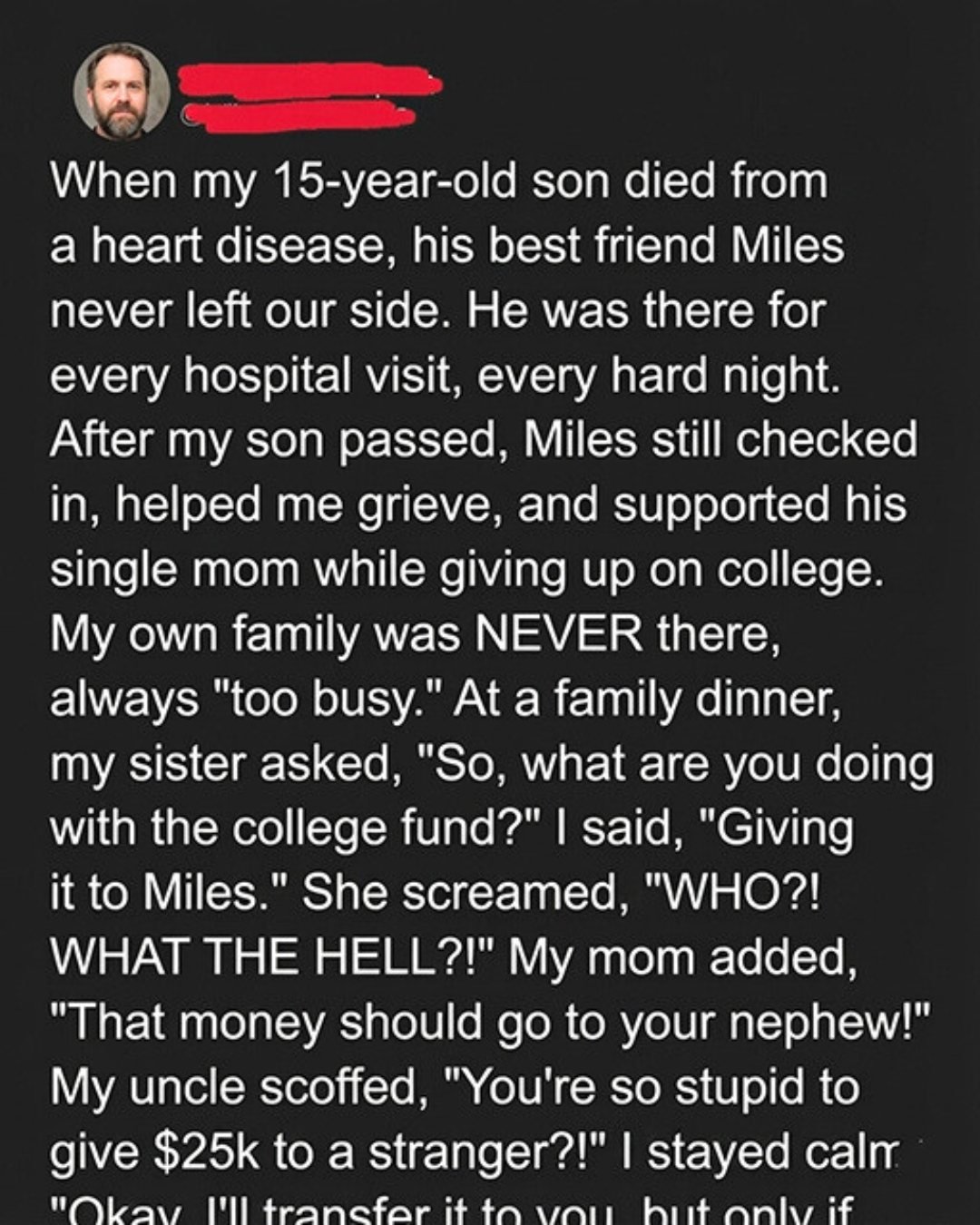
“I’m giving it to Miles,” I said.
The room exploded.
“That money should stay in the family.”
“It’s twenty-five thousand dollars.”
“My son needs help with college.”
I looked around the table.
“Where were you,” I asked quietly, “when my son was dying?”
No one answered.
“Who remembers Elliott’s last day?” I continued. “What song was playing? What were his last words?”
Silence.
“Miles was there,” I said. “He held Elliott’s hand. He stayed.”
Linda slammed the table. “That boy is nothing to us!”
“That boy,” I said, standing, “was everything to my son.”
I paused.
“Fine. I’ll give you the money. All of it. Under one condition.”
They leaned forward.
“Tell me about Elliott’s last moments.”
No one could.
“Miles starts college this fall,” I said. “And when I told him, he cried—not because of the money, but because someone believed in him.”
I left.

The Family We Choose
Three weeks later, I helped Miles move into his dorm. His sketches covered the walls. His textbooks sat neatly stacked.
“I don’t know how to thank you,” he said.
“You already have,” I replied. “By being who you are.”
As I drove home, my phone buzzed with an angry message from my sister. I deleted it without reading.
Family isn’t about blood.
It’s about presence.
It’s about who stays when everything falls apart.
Elliott understood that.
Miles understood that.
And now—finally—so do I.