I never imagined my life could fracture so completely because of a single sentence.
My daughter was seventeen when she gave birth. Still a child herself. Still in school. Still figuring out who she was — and suddenly carrying a responsibility far heavier than anything she had known.
One evening, she stood in my kitchen holding her newborn. She looked exhausted, but her voice was steady. She told me she planned to leave school and start working. Then she asked if I could care for the baby while she did — just until she could get on her feet.
In that moment, I didn’t hear fear.
I didn’t hear desperation.
What I heard — or what I told myself I heard — was entitlement.
Something inside me snapped.
Years of exhaustion surged to the surface. Working double shifts. Raising her alone after her father left. Giving up my own dreams so she could have a better future. All of it rushed out of me at once.
And before I could stop myself, I said words I can never take back.
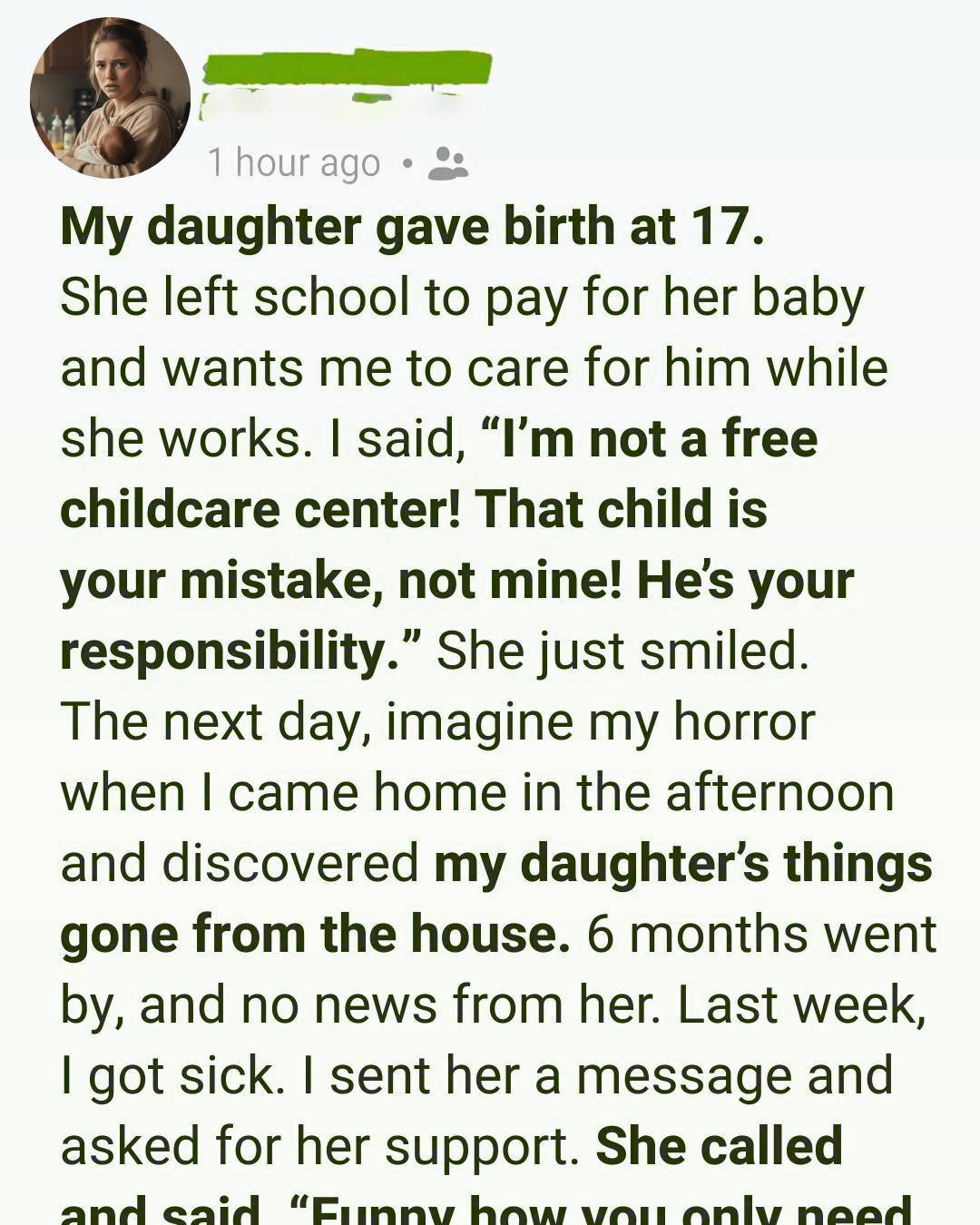
“I’m not a free childcare center.
That child is your mistake, not mine.
He’s your responsibility.”
She didn’t cry.
She didn’t argue.
She smiled — quietly, sadly — and nodded.
That smile should have scared me more than any shouting ever could.

The Silence She Left Behind
The very next afternoon, I came home to a silence that felt wrong.
The house was too empty.
Too clean.
Her shoes were gone.
Her clothes were gone.
The baby’s tiny blanket — the one she’d draped over the couch — was gone.
On the table sat a single note.
“You’re right, Mom. He’s my responsibility. So I’m moving out.
Since you made it clear you want nothing to do with your grandson, I’m honoring that.
Don’t expect visits.
Don’t expect calls.
You wanted boundaries. Here they are.”
I read it again.
And again.
It took hours before it truly sank in.
Six Months Without a Daughter
Six months passed.
No calls.
No messages.
No photos.
At first, I told myself she was being dramatic. I assumed she’d cool off. That reality would become too heavy and she’d come back asking for help.
But weeks turned into months.
The house stayed silent.
I found myself listening for sounds that never came — a baby crying at night, her footsteps in the hallway. I’d open the refrigerator and remember how she used to label bottles with dates and tiny hearts.
Then my body began to fail.
First, exhaustion.
Then numbness in my hands.
Then dizziness that wouldn’t go away.
After endless tests, a doctor finally said the words that hollowed me out:
Early-stage multiple sclerosis.
I went home shaking.

When I Needed Her
That night, I stared at my phone for a long time before finally texting her.
I told her I was sick.
I told her I was scared.
I told her I needed my daughter.
She called the next day.
Her voice was calm. Too calm.
“Funny how you only need family when you need help,” she said.
“That sounds like your responsibility, not mine.
I’m not a free nursing home.”
Those words cut deeper than the diagnosis itself.
I tried to remind her who I was.
“I’m your mother,” I said. “Not a stranger.”
There was a pause.
Then she answered softly:
“And I was your daughter when I asked for help.”
The line went dead.
A New Ending
Now I sit alone in this house — surrounded by memories, medication bottles, and questions with no clean answers.
I replay that moment in the kitchen again and again. The tone of my voice. The look on her face. That smile I misunderstood.
I tell myself I was setting boundaries.
That I had the right to protect my own life.
That love doesn’t mean sacrificing everything.
But late at night, when my hands tremble and the silence presses in, I wonder something else.
Maybe I didn’t teach her independence.
Maybe I taught her how to leave.
Because when she needed me, I called it a burden.
And when I needed her, she simply remembered the lesson.
I don’t know if I deserve forgiveness.
I don’t know if she owes me anything.

All I know is this:
Sometimes the price of standing your ground
is realizing too late
that you were standing alone.
And some boundaries, once drawn,
become walls that love can’t climb back over.
Note: This story is a work of fiction inspired by real events. Names, characters, and details have been altered. Any resemblance is coincidental. All images are for illustration purposes only.